
Prospect Company B2B Sales Outreach Facts: What Works in 2025

Knowing the right prospect company B2B sales outreach facts is no longer optional for modern sales teams — it is the difference between a pipeline that grows steadily and one that stalls despite effort. B2B outreach has changed significantly. Generic cold emails and scattershot contact lists no longer cut through. The organizations consistently building qualified pipeline in 2025 are not sending more messages; they are sending smarter ones.
This guide covers what your team needs to succeed: from understanding what sales outreach actually means in a B2B context, to researching companies effectively, scoring contacts on LinkedIn, applying strategies that reflect current buyer behaviour, choosing the right tools for your Microsoft 365 environment, and using analytics to time your outreach with precision.
What Is Sales Outreach and Why Does B2B Prospecting Depend on It?
Understanding what is sales outreach is the starting point for any team looking to improve performance. Sales outreach is the deliberate process of initiating contact with prospective customers who have not yet expressed interest in your product or service. In a B2B context, it encompasses cold email sequences, LinkedIn messaging, phone-based prospecting, and structured multi-channel campaigns designed to generate conversations with decision-makers at target companies.
The B2B dimension adds complexity that consumer-facing outreach rarely requires. Decisions typically involve six to ten stakeholders, sales cycles span weeks to months, and the research required before contact is far more detailed than a simple name and email address.
Several prospect company B2B sales outreach facts illustrate why strategy consistently outperforms volume:
- Personalized emails generate significantly higher engagement than generic templates across all B2B sectors
- Over 80% of B2B deals require at least five follow-up touchpoints before a prospect responds
- Multi-channel outreach sequences reliably outperform single-channel campaigns
- The majority of cold emails are opened on mobile devices, making subject line clarity and brevity essential
These outreach facts explain why the sales teams producing the best results in 2025 invest in research, relevance, and structured sequencing rather than raw send volume.
How to Research Companies for Effective B2B Sales Outreach
Knowing how to research companies for sales outreach separates high-performing SDRs from those churning through lists with minimal returns. Reaching out to a prospect company without meaningful prior research produces weak reply rates, wastes sequences on poor-fit accounts, and signals clearly to the recipient that you do not understand their business.
Key Data Points to Gather Before Reaching Out
Effective company research for B2B sales outreach requires capturing five core data categories:
- Company size and revenue range — Confirms whether your solution fits their operational scale and purchasing budget
- Technology stack — Reveals whether your product integrates with existing tools or needs to replace something already embedded in their workflow
- Recent business triggers — Funding announcements, leadership changes, market expansions, or significant hiring activity signal buying readiness and give you a timely, specific reason to reach out
- Industry and vertical — Directly shapes which pain points you reference and how you frame your value proposition
- Decision-maker hierarchy — Understanding who controls the budget versus who influences the decision changes your entry point and messaging approach entirely
The goal of company research is not data collection for its own sake — it is identifying the specific trigger that makes your B2B sales outreach feel relevant and timely rather than random and intrusive. Relevance is what converts a cold message into a conversation.
Using LinkedIn Contact Scoring for Sales Outreach
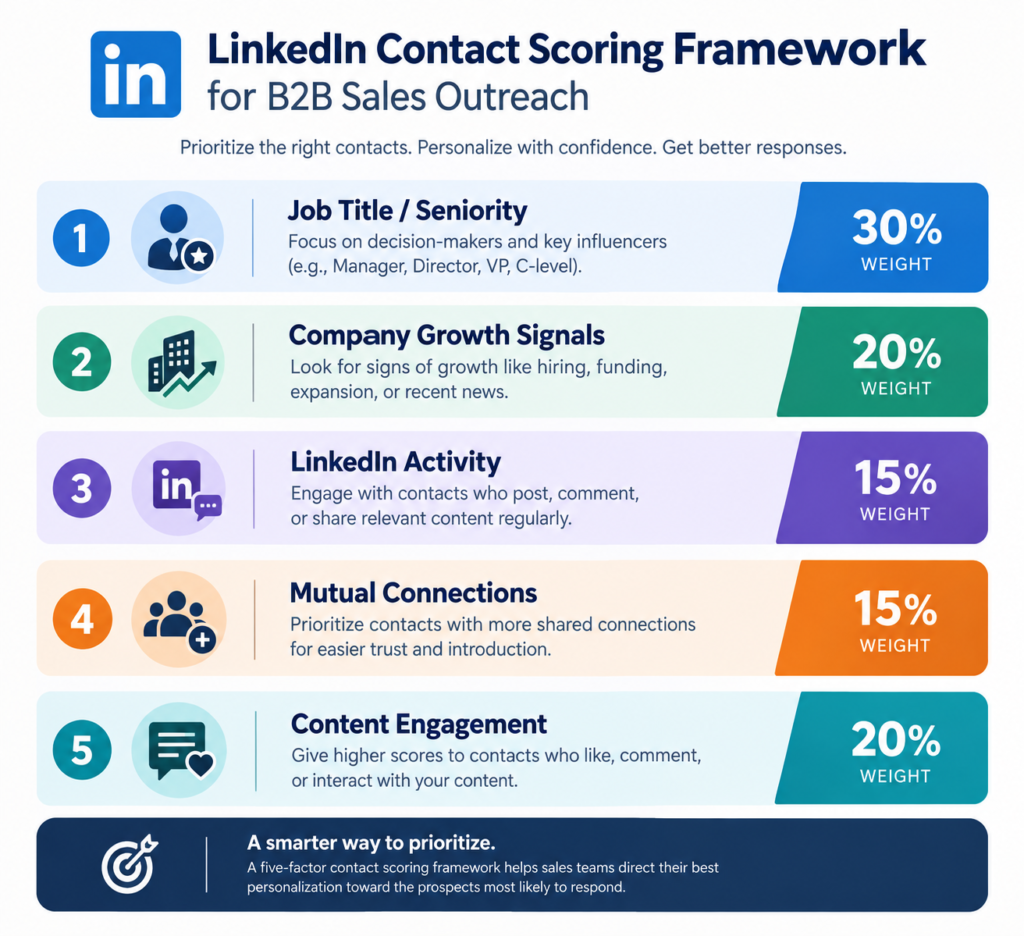
LinkedIn contact scoring for sales outreach is one of the most effective prioritization techniques available to modern sales teams. Rather than sequencing every contact with a relevant job title, scoring assigns a weighted value to each individual based on objective signals — ensuring your highest-effort personalization is directed toward the prospects most likely to respond.
A practical scoring framework might weigh the following factors:
- Job title and seniority (30%) — Is this person a budget holder or an influencer?
- Company growth signals (25%) — Is the company expanding, hiring in relevant functions, or raising capital?
- Recent LinkedIn activity (20%) — Active users engage with direct outreach more readily than dormant profiles
- Mutual connections and shared groups (15%) — Relationship proximity materially increases reply probability
- Engagement with your company content (10%) — Prior engagement signals existing awareness of your brand
Applying LinkedIn contact scoring systematically ensures that lower-priority contacts enter automated nurture sequences while your top-scoring prospects receive personalized, high-value outreach — the distinction that drives disproportionate results.
B2B Sales Outreach Strategies That Drive Results in 2025
The most effective B2B sales outreach strategies in 2025 share three defining characteristics: they are research-led, multi-channel, and personalized at scale. Outreach volume without relevance generates noise, not pipeline. What separates the best-performing teams is not how many messages they send but how precisely each message connects to the recipient’s current situation.
Best Practices: Automating Outreach with Personalization and Analytics
One of the most important best practices to automate sales outreach personalization and analytics is to treat automation and personalization as complementary disciplines rather than opposing ones. Modern sales outreach tools allow teams to run high-volume sequences while preserving the specific, relevant details that make each message feel considered — not mass-produced.
Practical steps for achieving this balance:
- Segment your prospect list before building any sequence — Group companies by industry, trigger type, and company size to create messaging specific enough to resonate within each segment
- Build personalization fields for company-specific details — Pull in recent news, specific role context, or technology stack information automatically at scale
- A/B test subject lines and opening lines continuously — Small improvements in open rates compound significantly across thousands of contacts
- Monitor engagement analytics at the individual prospect level — Open rates, reply rates, and click-through data indicate which messaging is landing and which needs rework
- Route replies by sentiment automatically — Positive, neutral, and negative replies each require a distinct follow-up approach; automated routing ensures no warm lead falls through the cracks
Mastering Inbox Categories for Smarter Outreach Management
As outreach volume grows, the ability to master inbox categories for sales outreach becomes operationally essential. Without a structured reply management system, warm leads get buried under volume and opportunities are missed at the exact moment they are most accessible.
Effective inbox categories for a functioning B2B outreach operation include:
- Interested / Hot Lead — Ready for a meeting; move immediately into booking sequence
- Nurture / Future Interest — Open to the conversation but not ready now; enter long-cycle follow-up
- Objection / Not Now — Requires tailored objection-handling or scheduled re-engagement after a defined interval
- Unsubscribe / Do Not Contact — Remove from all active sequences immediately and maintain a permanent suppression list
- Auto-Reply / Out of Office — Schedule re-engagement for a specific date after the stated return
Integrating these categories directly into your CRM or outreach platform ensures every reply receives the appropriate action and that no warm prospect gets buried by volume.
Best Sales Email Outreach Tools with Microsoft 365 Outlook Integration in 2025
Choosing the right platform is one of the highest-impact decisions a sales team makes. The best sales email outreach tools with Microsoft 365 Outlook integration in 2025 allow teams to manage sequences, track engagement, handle replies, and sync activity data without leaving the email environment they already use every day — reducing friction and improving data consistency.
Key capabilities to evaluate when selecting your sales outreach tools:
- Native Outlook integration — Full bidirectional sync with no forwarding workarounds or unreliable data transfer
- Conditional sequence branching — Automatically adjusts the outreach path based on specific prospect behaviour such as opens, clicks, or link engagement
- Campaign and individual-level analytics — Both aggregate performance data and prospect-specific engagement insights visible within the same interface
- Automatic sequence pausing on reply — Prevents follow-ups from delivering after a prospect has already responded
- Built-in compliance management — GDPR, CAN-SPAM, and unsubscribe handling embedded into the platform rather than managed manually
Teams operating within the Microsoft 365 ecosystem gain the most from tools that treat Outlook as the primary interface rather than a secondary add-on — keeping sequences, tracking, and reply management in one familiar environment.
Reply Guidance, Templates, and Examples for B2B Sales Outreach
Even thoroughly researched prospect lists underperform without strong messaging. B2B sales outreach reply guidance, templates, and examples give your team a proven structural framework that can be adapted for each company, role, and trigger — without writing every message from scratch.
A high-performing B2B cold email structure:
- Subject line: Specific, curiosity-driven, and under eight words — avoid formats that read as mass emails
- Opening line: A company-specific observation tied to a recent trigger — not a generic compliment
- Value proposition: One clear sentence connecting their specific situation to a meaningful, realistic outcome
- Soft CTA: A single low-friction ask — a question or a brief conversation request, not a direct calendar link on a first contact
Template example:
Subject: Quick question about [Company]’s [specific challenge]
Hi [First Name],
I noticed [Company] recently [specific trigger — hiring surge, new funding, product expansion]. Teams in similar positions often encounter [relevant pain point] as they scale.
We help [target company type] [specific, realistic outcome] — and I’d love to share how we could do the same for you.
Would a 15-minute call be worth your time this week?
Adjust the template based on industry vertical, the seniority level of the contact, and the specific trigger that made this prospect worth reaching out to at this moment. The trigger is always the most critical variable.
Industry Standards and the Association for B2B Sales Outreach
Understanding how your outreach performance compares to industry benchmarks provides the context needed to diagnose problems accurately. The association for B2B sales outreach — including professional bodies such as the Revenue Enablement Society (formerly AA-ISP), RAIN Group, and the Sales Management Association — publishes research, standards, and survey data that give teams a credible performance baseline.
Key benchmark ranges worth tracking against your own data:
- Cold email open rate: 21%–28% across B2B sectors
- Reply rate for well-personalized campaigns: 8%–15%
- Meeting conversion from positive reply: 25%–40%, depending on industry and offer
Comparing your prospect company B2B sales outreach facts against these published ranges helps identify whether underperformance is rooted in a messaging problem, a targeting problem, or a volume shortfall — and it points your team toward the right area to address first rather than applying fixes blindly.
Leveraging the Datafast Analytics Platform for Outreach Opportunities
Analytics platforms have become increasingly central to how effective sales teams identify B2B outreach opportunities before their competitors notice the same signals. The Datafast analytics platform sales outreach opportunity model reflects a broader shift toward intent-led prospecting — using signals from a company’s research behaviour, technology adoption patterns, and growth indicators to time outreach precisely rather than speculatively.
When an analytics platform is integrated into your outreach workflow, your team can:
- Prioritize prospect companies showing active purchase-intent signals in your category
- Score target accounts dynamically as new firmographic and behavioural data becomes available
- Sync opportunity signals directly into CRM-based outreach sequences, triggering the right cadence at the right moment
- Identify which outreach channels — email, LinkedIn, or phone — are producing the most qualified conversations within each industry segment
Using data-led signals to time your prospect company B2B sales outreach ensures your messages reach companies when they are actively evaluating solutions — rather than interrupting them at a random point in their business calendar. This shift from volume-led to signal-led outreach is what separates consistently high-performing sales teams from those chasing unpredictable results.
Frequently Asked Questions
What is the ideal length for a B2B cold outreach email?
Keep it under 150 words. Decision-makers scan rather than read. Lead with your most relevant observation, connect it to their specific situation, and end with a single, low-friction ask. Relevance matters far more than length — a three-sentence email with a strong trigger consistently outperforms a detailed pitch that fails to connect quickly.
How many touchpoints does effective B2B sales outreach require?
Research across the industry consistently shows that six to eight touchpoints across multiple channels produce the strongest reply rates. Single-email campaigns significantly underperform multi-step sequences, even when the first message is well-crafted. Persistence combined with relevance is the formula that works.
How does LinkedIn contact scoring improve outreach efficiency?
It removes guesswork from prioritization. Rather than reaching out based on job title alone, contact scoring layers in engagement signals, company growth data, and relationship proximity — ensuring your highest-effort personalization is directed at the prospects statistically most likely to respond and convert.
What makes Microsoft 365 Outlook integration important in sales outreach tools?
It keeps sequences, engagement tracking, and reply management inside the tool your team uses daily — eliminating context-switching, maintaining data hygiene, and making compliance management for GDPR and CAN-SPAM far more consistent across the organization.
What role does the association for B2B sales outreach play in benchmarking?
Professional associations and independent research bodies publish benchmark data on open rates, reply rates, and conversion rates that allow sales teams to evaluate performance objectively. Without external benchmarks, teams often set unrealistic targets or tolerate underperformance that structured measurement could quickly identify and correct.
Conclusion
The prospect company B2B sales outreach facts are clear: consistent pipeline in 2025 belongs to sales teams that invest in company research, apply intelligent contact scoring, use sales outreach tools that work within their existing Microsoft 365 workflow, and time their outreach using analytics rather than intuition.
Start where it counts: understand your prospect’s business thoroughly before crafting any message. Apply LinkedIn contact scoring to direct your best personalization where it will have the greatest impact. Manage your inbox systematically so no warm reply is wasted. And use data-led platforms to reach companies when they are actively seeking solutions — not just when your calendar says it is time to follow up.
Outreach that is genuinely relevant, precisely timed, and consistently followed up does not feel like cold outreach to the recipient. That is the standard worth building toward — and the facts in this guide give you the framework to get there.
Ready to identify your highest-value outreach opportunities? Explore how a data-led analytics and outreach platform can help your team find and engage the right prospect companies at exactly the right moment.